

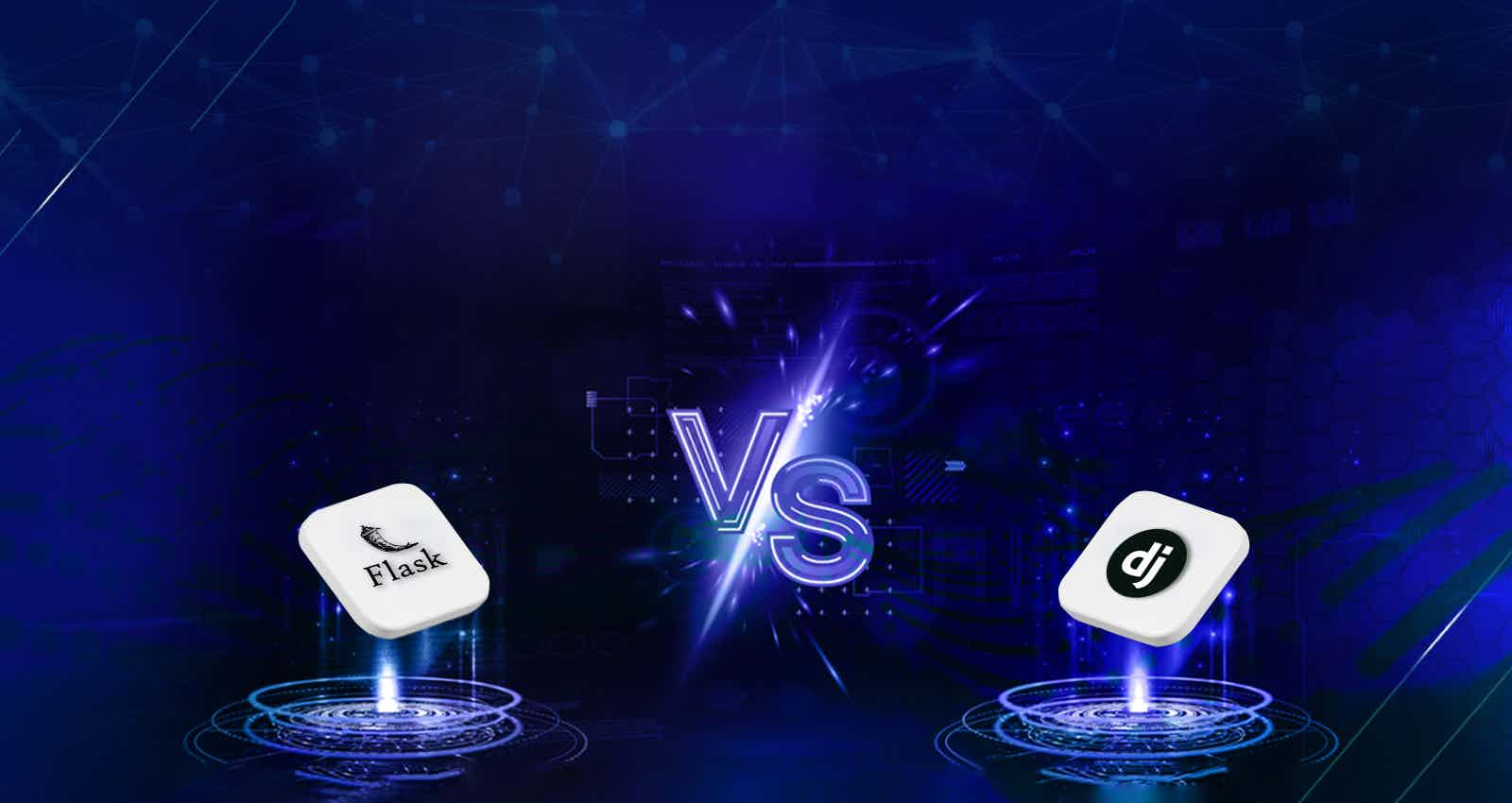
Flask vs Django:
Which Python Framework Is Right for You?
Jan 3, 2023Python as a programming language is known for its vast assortment of web frameworks that web developers use across the globe to build websites based on their tasks and project spectrum. And among all the various web development frameworks, Flask and Django are the most popular. Now both frameworks come with their own set of unique features and similarities; therefore, choosing one over the other often becomes a confusing choice for a web application development company. Therefore in this blog, we shall assess both frameworks assorted with Python web development and with our comparative analysis help you decide which framework suits your next web application development project best.
Flask
Flask is the best known micro web framework written in Python. Developed by Poocco, a team of Python enthusiasts led by Armin Ronacher, Flask does not require particular set of tools and libraries, has no database abstraction layer and form variation being a micro framework. Flask web development framework is lightweight and easy to use, especially for novice developers who can readily build a web application by using a single Python file.
There are several big entities that have employed Python Flask to develop their virtual presence like:
- Netflix
- Airbnb
- Mozilla
- MIT and many more.
Some of the best features that Flask offers are:
Independence – Flask is independent and flexible enough to enable developers to create application and experiment with the libraries and the architecture of the framework.
Integrated Unit Testing – Flask’s IUT enables quick debugging, freedom to experiment and develop robust.
Compatibility – Flask is highly compatible with all the latest technologies like Cloud, Machine Learning and more.
Django
For those developers who run tight on theri deadlines, Django is just for them. Django developers are enabled to render clean and pragmatic designs at rapid pace as it deals with the asic development function super quick, be it site map, client information, content organizing and much more. Thus when it comes to Django web development with Python, developers get a framework that renders quality, efficiency and rapidness.
There are several big entities that have employed Python Django to develop their virtual presence like:
- National Geographic
- Spotify
- Coursera
- Udemy
Some of the best features that Django offers are:
Fast – Djang is hands down fast, right from concept to completion.
Adaptable – it is adaptable with formats like JSON, XML, HTML and many more.
Scalable – since every layer in Django is independent, altering and updating different layers is cost effective and effortless, thus ensuring scalability.
Flask vs. Django: A comparative analysis
Both Django and Flask have their individual set of features and characteristics with distinguished functionalities and usages, however to ascertain which will suit your project demands better, we shall now draw a comparative analysis of their pros and cons and features.
| Parameters | Flask | Django |
| Framework Type | Lightweight
Minimalist features Abundant features without external library |
Full stack
Ready-to-use solutions |
| Data Model | Modular approach | Object oriented approach |
| Project Layout | Suitable for single page applications | Suitable for multiple page applications |
| Bootstrapping Tool | Does not have one | In-built bootstrapping tool |
| Database Support | Does not support basic management system, uses SQLAlchemy | Supports popular management systems, uses MySQL, Oracle |
| Flexibility | Micro-based | Less flexible, changes to module not possible |
| Template Engine | Uses Ninja2 template | Inspired by Ninja2 template but has built-in model view |
| Control | Complete control over creating applications | No control over tools and functions |
| Working style | Diversified | Monolithic |
| Debugger | Virtual debugging enabled | Virtual debugging not enabled |
| Routing & Views | Supports mapping of URL to class-based view with Werkzeug | Supports mapping of URL |
| Structure | Random | Conventional |
| HTML | Does not support dynamic HTML pages | Supports dynamic HTML pages |
| Source | Open-Source | Open-Source |
Bottom Line:
One is an open-source framework that enables rapid development while the other is a light-ended framework for developing functionalities. While, Django helps building sophisticated application, it demands vast knowledge, while Flask extends complete control and specifically leverageable for small projects that want to do experimentation with the module and architecture of the framework.

